EBBY T.
The Man Who Carried The Message To Bill W.
By Walter L.
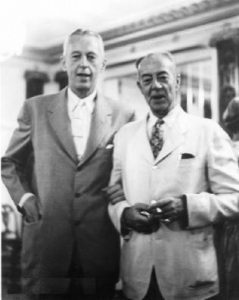
In 1960, at the Long Beach, California Convention of Alcoholics Anonymous, Bill Wilson wrote this dedication in an AA book that he gave to Ebby Thacher.
“Dear Ebby,
No day passes that I do not remember that you brought me the message that saved me – and only God knows how many more.
It was Ebby who found relief from his alcoholism in the simple spiritual practices of the Oxford Group which was an attempt to return to First Century Christianity – before it was complicated and distorted by religious doctrines, dogma and opinions. The program offered by Ebby to Bill involved taking a personal moral inventory, admitting to another person the wrongs we had done, making things right by amends and restitution, and a genuine effort to be of real service to others. In order to obtain the power to overcome these problems, Ebby had been encouraged to call on God, as he understood God, for help.
Bill was deeply impressed by Ebby’s words, but was even more affected by Ebby’s example of action. Here was someone who drank like Bill drank – and yet Ebby was sober, due to a simple religious idea and a practical program of action. The results were an inexplicably different person, fresh-skinned, glowing face, with a different look in his eyes. A miracle sat directly across the kitchen table from Bill. Ebby was not some”do-gooder” who had read something in a book. Here was a hopeless alcoholic who had been completely defeated by John Barleycorn, and yet, had in effect, been raised from the dead. It was a message of hope for an alcoholic – that God would do for us what we could not do for ourselves.
Bill continued to drink in a more restrained way for a short while, and then was admitted to Towns Hospital on December 11, 1934. Ebby visited him there on December 14th and essentially helped Bill take what would become Steps Four, Five, Six, Seven and Eight.
But that “boost” from Ebby’s visit wore off and that night, Bill’s feeling of hopelessness deepened and a terrifying darkness yawned in the abyss. As the last trace of self-will was crushed, Bill said to himself, with neither faith nor hope,
“I’ll do anything, anything at all! If there be a God, let Him show Himself!”
The Conference approved biography, Pass It On, quotes Bill as describing this experience:
“What happened next was electric. Suddenly, my room blazed with an indescribably white light. I was seized with an ecstasy beyond description. Every joy I had known was pale by comparison. The light, the ecstasy – I was conscious of nothing else for a time.
Then, seen in the mind’s eye, there was a mountain. I stood upon its summit, where a great wind blew. A wind, not of air, but of spirit. In great, clean strength, it blew right through me. Then came the blazing thought, “You are a free man.” I know not at all how long I remained in this state, but finally the light and the ecstasy subsided. I again saw the wall of my room. As I became more quiet, a great peace stole over me, and this was accompanied by a sensation difficult to describe. I became acutely conscious of a Presence, which seemed like a veritable sea of living spirit. I lay on the shores of a new world.”
Ebby had carried the message of the Oxford Group to Bill with great care and dedication—that recovery from alcoholism was possible using spiritual principles, but only if it was combined with practical actions. Bill Wilson never took another drink, and left Towns Hospital to dedicate the rest of his life to carrying the message to other alcoholics.
Ebby, however, took a different path, one that caused him to have a series of relapses. The man whom Bill Wilson called his sponsor could not stay sober himself, and became an embarrassment. There were periods of sobriety, some long, some short, but eventually Ebby would, “fall off the wagon,” as he called it.
More revealingly, Ebby referred to his periods of sobriety as, “being on the wagon.” For an AA to regularly use this sort of language is an indication that the commitment to sobriety is temporary in nature. If there is an “on the wagon” then there is an “off the wagon” too. And that was the on/off cycle of Ebby’s drinking.
Ebby was born on April 29, 1896, into a prominent and well-to-do family in Albany, New York, with roots going back before the American Revolution. His grandfather started a railroad wheel manufacturing business in 1852 and became the main supplier of wheels for the New York Central Railroad, as well as Mayor of Albany Two other members of Ebby’s family were also mayors of Albany, including his older brother, “Jack.” One of New York State’s most beautiful parks, located on the Helderberg escarpment southwest of Albany, was donated by the widow of Ebby’s uncle, John Boyd Thacher and is named after him.
Ebby’s full name was Edwin Throckmorton Thacher and he can be said to have arrived in the world with “a silver spoon in his mouth.” It is possible that because of his upper-class origins, with servants waiting on him and the respect brought by his family name, Ebby developed the attitude that life should always be easy for him. He was ‘entitled’, it seems.
Lois Wilson shared her insights into Ebby in her biography, Lois Remembers, and stated that while Bill wanted sobriety with his whole soul, Ebby appeared to want just enough sobriety to stay out of trouble. In addition, Lois said, “Beyond that crucial visit with Bill, Ebby seemed to do very little about helping others. He never appeared really a member of AA. After his first slip, many harmful thoughts seemed to take possession of him. He appeared jealous of Bill and critical, even when sober, of both the Oxford Group and AA.” Lois felt that it was important that AA’s know why Ebby was not considered the founder of AA. Ebby carried the message to Bill, but he never followed it up with the years of devoted action needed to develop the AA program.
Despite his failure to follow through after his vital visit with Bill, Ebby still seemed to feel he was not recognized adequately for his contribution to the start of AA. His employer for many years in Texas said that Ebby, “kind of thought the world owed him a living, to a certain extent. He thought he never got the recognition that he should. That was stuck in his craw for years.”
Another AA who had known Ebby in Texas said that, “Ebby held a deep resentment for Bill, Dr. Bob, and others, because he felt he was more the founder of what was to become AA than anyone else”. In the author’s opinion, this resentment may be the reason for his repeated “slips” in the program.
Ebby also had the idea that he needed the right woman and an ideal job in order to stay sober. The implication is that if he didn’t have the perfect woman and the perfect job, he couldn’t stay sober. And he didn’t stay sober. AA members know that sobriety has to be sought without any conditions, that we have to be “willing to go to any length to get it” and that “half measures availed us nothing.”
Some of Ebby’s own letters bring to mind Lois’s observation noted earlier, that Ebby seemed to be “around” AA, but never really “in” it. Typical correspondence from AA’s devotes substantial discussion to the AA Program and the application of the Steps to their own lives. Ebby’s letters avoid these topics and are significant for what they don’t say. In 1954, Bill wrote that Ebby now, “shows more signs of really joining AA than ever before.” The implication is that Ebby had shown less commitment to the AA program before then, but even at that time, there were still substantial doubts about his sincerity.
Earlier, in 1947, his sister-in-law received a letter from Ebby, and she wrote back suggesting that the answer to his problems was to devote himself to helping others and then continued,
“But as I read your letter this thought is far from your mind and you are again concerned with the petty and material affairs of your surroundings and the bickerings and by-plays of your associates, with the thought still deep in your mind that you have been persecuted and discriminated against by others, while the real facts might well be that it is your own ego that is at fault.”
Ebby drifted in and out of sobriety, and in and out of AA, with many AA members trying to help him regain a more stable sobriety. The person who was ultimately successful was Searcy W., who had established a hospital for alcoholics in Texas. Early in 1953, Searcy had asked Bill what he would like to see happen in AA, and Bill said, “I would like for Ebby to have a chance to sober up in your clinic.” Several months later, it came to pass, and after a short slip in 1954, Ebby remained sober for seven years.
In 1961, Ebby’s girlfriend died and the next day Ebby got drunk. He apparently still believed that his sobriety was conditional on having the right woman, and now she was gone. Ebby moved back to New York and lived at several places for the next two years, one of which was at his brother Ken’s home in Delmar, a suburb of Albany. He had emphysema, the same disease that caused Bill’s death, and was in poor health, his weight having dropped from 170 to 122 pounds.
Ebby eventually came to Margaret and Micky McPike’s farm outside Ballston Spa, New York, in May, 1964 and it was under their loving care that he finished the final two years of his life, dying sober on March 21, 1966. While at McPike’s farm, he never even attempted to get something to drink although he never attended any AA meetings. Still, AA visitors were frequent and AA principles were in constant evidence, permeating the entire atmosphere at McPike’s. Dr. Bob said that the AA program boiled down to love and service and that was the essence of Margaret and Micky McPike, who helped more than four thousand persons to recover from alcoholism. Ebby was one of them.
AA’s agree that no matter what happens to them, the most important thing is to not pick up that first “sucker” drink. Once alcohol is placed in our bodies, the results are physically inevitable in the same way that once a dose of castor oil has been taken, all the mental will power in the world is of no avail. Our problem as alcoholics centers in our minds, in having an entire psychic change as a result of taking the actions set out exactly in the 12 Steps. It is said in the rooms, “If you do what we did, you’ll get what we got.” Ebby was unable, for whatever reasons, to put the AA program of action into his life on a regular basis.
All of his life, Ebby was overshadowed by the recognition and success of his father and grandfather and in his own generation, by the accomplishments and respect given to his older brothers. This may have developed in him a sense of “never good enough” so familiar to alcoholics. It is also likely that his privileged childhood accentuated the sense of self-importance and self-focus that the AA program requires us to deflate at depth.
If Ebby had been recognized as the founder of the AA program, it would have given him respect and recognition far surpassing anyone in his family. After Bill received the message of recovery from Ebby, he devoted the rest of his life to helping other alcoholics. If Ebby had been willing and able to take similar actions of love and service, he would have been a co-founder with Bill Wilson. But he would not, or could not, do the day-to-day work with others needed to bring AA into a concrete reality.
Rather than realistically looking at his own shortcomings in establishing AA, Ebby wallowed in resentments, the greatest obstacle to sobriety and the number one killer of alcoholics. Perhaps Bill was thinking of the example of his sponsor, Ebby, when he wrote the many strong statements in the Big Book condemning resentments. For whatever the reasons, Ebby never seemed to give himself completely to the simple program of Alcoholics Anonymous.
There are many others who achieve periods of sobriety yet relapse from time to time. They are not to be condemned, but welcomed back into the Fellowship. Their experience is a lesson to others that alcohol as an enemy is indeed cunning, baffling and powerful. If anyone might feel smug or superior, he or she should be grateful that they have not gotten that bad – yet.
If there is a Higher Power, then by implication there is a lower power. And the lower power can never win, unless we give up. Despite many slips, Ebby never gave in to the lower power and always came back. He ran the race; he kept the faith and died sober. Ebby deserves to be honored for carrying the message of spiritual recovery to Bill and for acting as his sponsor. Whatever his problems may have been with sobriety, Bill was always grateful to Ebby and so should all AA’s.
Bill said, in “The Language of the Heart”, “Ebby had been enabled to bring me the gift of grace because he could reach me at depth through the language of the heart. He had pushed ajar that great gate through which all in AA have since passed to find their freedom under God.”
Much of the above material is synthesized from Ebby’s biography by Mel B., Ebby-The Man Who Sponsored Bill W., published by Hazelden. Other material was taken from sections of Conference approved books listed in the reference section below. Comments and inferences in the article are the opinion of the author.
References:
Alcoholics Anonymous (The Big Book). Alcoholics Anonymous World Services, Box 459 Grand Central Station, New York, NY 10163.
AA Comes of Age. Alcoholics Anonymous World Services, Box 459 Grand Central Station, New York, NY 10163.
Language of the Heart. Alcoholics Anonymous World Services, Box 459 Grand Central Station, New York, NY 10163.
Lois Remembers. Al-Anon Family Group Headquarters, 1600 Corporate Landing Parkway, Virginia Beach, VA 23454-5617.
Pass It On. Alcoholics Anonymous World Services, Box 459 Grand Central Station, New York, NY 10163.