Ebby
This article originally appeared in the Grapevine,
Volume 56, Issue 4 (September 1999)
|
“Ebby had been enabled to bring me the gift of grace because he could reach me at depth through the language of the heart. He had pushed ajar that great gate through which all in AA have since passed to find their freedom under God.” — Bill W., Grapevine
|
While attending the annual Bill W. dinner in New York in October 1963, I noticed a man with a sad expression seated at the table that Bill and Lois shared with close friends. Since the general atmosphere in the large banquet room was festive, his sadness seemed out of place. Someone told me he was Ebby T., the friend who had called on Bill in late 1934 to bring him the Oxford Group’s spiritual message that helped Bill get sober and helped form AA.
Several months later, during one of the last discussions I ever had with Bill, he told me that he had been able to place Ebby in a country rest home in upstate New York. Ebby died two years later from emphysema, the same affliction that would claim Bill’s life in 1971.
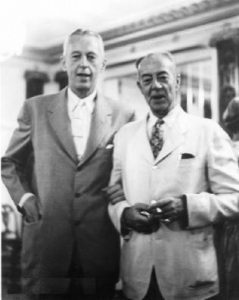
Bill Wilson (left) and Ebby Thacher (right)
in 1955, two years after Searcy W. got him
sober at his clinic in Dallas, Texas
Ebby’s physical problems had been compounded by his frequent bouts with alcohol during the years since he had carried the message to Bill. His was the kind of story that causes continuing anguish in AA: a wonderful burst of initial sobriety followed by a devastating slip and then a pattern of repeated binges despite his best efforts and those of his friends. He had a tortured life, and yet there were times when he struggled valiantly to put his demons to rest.
I never actually met Ebby, but I kept learning more about him as the years passed. While serving as a contributing writer to Pass It On in 1980 and 1981, I had access to the correspondence that flowed between him and Bill. There was also an opportunity to spend a day with Margaret, the kindly nurse who cared for Ebby during his last two years of life.
In Albany, New York’s capital city, there is archival information in the state library about Ebby’s distinguished family members and their achievements in politics and business. Three members of the T. family were Albany mayors, and one lost a gubernatorial nomination by a very narrow margin. Ebby’s parents were also prominent in social and church affairs. An assistant to the mayor at that time told me “you couldn’t find a better family than the T.’s” and put me in touch with Ebby’s nephew, Ken T., Jr. When I returned to Albany some years later, Ken took me to visit Ebby’s grave in the Albany Rural Cemetery, just north of the city.
There’s no denying that Ebby was the “lost sheep” of the family, but it never completely rejected him or lost hope that he might someday recover. His last surviving brother, Ken T., Sr., stayed loyal to him right up to the time of his own death, just a few months before Ebby’s passing.
But if Ebby had a friend who was unfailingly loyal and devoted, it was Bill W., who always called Ebby his sponsor and seemingly moved heaven and earth in trying to help Ebby regain sobriety. Indeed, it almost seemed that Bill threw his own good judgment out the window and became an “enabler” when Ebby was involved. The late Yev G., a member of the Manhattan Group since 1941, told me in 1980 that Bill seemed to lose all perspective when Ebby went off on another drunk. Yev recalled it this way:
“Bill was so definitely concerned about Ebby and so fond of him and felt so grateful and indebted to him that he would do anything rather than have anything happen to Ebby. Some of us were Bill’s selected emissaries to find Ebby when he went out on one of his episodes. We knew his watering holes, the rooming houses, and the places where he went. So we’d get him and bring him back in the group, and he’d go along very well. But we had to observe, really, that Bill did not treat Ebby with the same kind of approach that he realistically would with the average kind of alcoholic member we had in those days in New York.”
But even Bill became exasperated with Ebby at times, and this is revealed in some of his correspondence with and about Ebby. But he never lost hope that Ebby would recover, and years after his own recovery he would tell Ebby of his gratitude. It was an astonishing friendship, and one early AA told me that Bill and Ebby were almost like brothers.
A brief outline of Ebby’s life goes this way: he was born in Albany in 1896, the youngest of five brothers. His father headed a family-owned foundry that manufactured railroad-car wheels, and Ebby entered life with the proverbial silver spoon in his mouth. Like his brothers, he attended Albany Academy, a prestigious private school that is highly regarded and whose graduates usually go on to college. But though his brothers excelled at the academy, Ebby was a lackluster student and did not graduate.
The family spent their summers in the resort town of Manchester, Vermont, seven miles south of Bill’s hometown, East Dorset. Ebby’s father was a golfing partner of Robert Todd Lincoln, a wealthy industrialist and the only son of Abraham Lincoln to reach adulthood. Lois’s family was also a member of this social group, the “summer people” who awed Bill as he was growing up. Although Bill felt inferior in status to Ebby’s family and Lois’s family, he was something of a hero to other boys in Manchester because of his skill as a baseball pitcher. Ebby remembered meeting him in 1910 or 11 and perhaps watched him play.
Ebby may have sipped a little wine on family occasions, but he didn’t have his real first drink until 1915, at age nineteen, when he walked into Albany’s Hotel Ten Eyck and ordered a glass of beer. At about the same time, he went to work in the family business. By the time the firm closed in 1922, Ebby was getting drunk frequently. Later on in the nineteen-twenties he worked in the Albany office of a brokerage firm, but there’s reason to believe he was never a real producer. In the meantime, Bill W. had become a New York stockbroker and was soaring with the surging market on Wall Street.
In January 1929, Bill stopped in Albany on his way to visit friends in Vermont, and he gave Ebby a call. He and Ebby spent the evening drinking and then agreed on a daring way to arrive in Manchester: by air, a risky action in those early days of aviation. They hired a barnstorming pilot to fly them to Manchester, which had just built an airfield, and they arrived, very drunk, the next day. Bill recalled (as quoted in Pass It On): “We somehow slid out of the cockpit, fell on the ground, and there we lay, immobile. Such was the history-making episode of the first airplane ever to light at Manchester, Vermont.” Their drunken venture may have created an odd bond between Ebby and Bill that would be among the reasons Ebby would call on him in 1934.
Ebby’s drinking worsened, and by late 1932 he had become such an embarrassment to his family that he slunk off to Manchester, and moved back into his family’s summer home. He had periods of sobriety, but by mid-1934 his drinking had led to troubles and arrests in Manchester. While his brothers were still actively employed or in business, the family money supporting Ebby had largely run out. According to some tales circulated later, he sold some of the family furniture to buy booze.
About this time, several Oxford Group members in the area chose Ebby as a likely prospect for their spiritual message. They were Rowland H., Shep C., and Cebra G. He resisted their approach, but became more receptive when another drunken incident brought him before a judge in Bennington. He expected to be jailed for the weekend, but was permitted to go home on the promise that he would return — sober — on Monday.
And it was at this point, I think, that Ebby won a battle that became important for all of us. Waiting for him in the cellar at home were several bottles of his favorite ale, which he planned to drink immediately after the local constable let him off at the house. He was in agony when he raced down the stairs to get them. But then his promise to the judge stopped him cold, and he began to wrestle with his conscience. After a fierce struggle he took the bottles over to a neighbor. The action gave him peace. That was his last attempt to drink for two years and seven months.
I like to think of this moment as Ebby’s Magnificent Victory. I’ve wondered whether, if he’d lost this struggle, he might not have stayed sober and been able to carry the message to Bill. In any case, he returned to court sober and was released to the custody of Rowland H., who then became what we AA’s would call a sponsor. Along with giving Ebby a grounding in Oxford Group principles, Rowland took him to New York City. After staying with Shep for a short time, Ebby moved to Calvary Mission, run by Dr. Sam Shoemaker’s Calvary Church on Gramercy Park.
One November night in 1934, Ebby came to see Bill, who was then living in Brooklyn with his wife, Lois. Ebby told Bill, “I’ve got religion,” and while Bill drank gin and pineapple juice, Ebby recounted his friendship with Rowland, described the principles of the Oxford Group (like the importance of absolute honesty when dealing with defects), and talked about his growing belief in God and the efficacy of prayer. Ebby’s words, and his sober demeanor, stayed with Bill, who later recalled, “The good of what he said stuck so well that in no waking moment thereafter could I get that man and his message out of my head.” Bill kept drinking, but he decided to pay a visit to the mission, which he did after stopping at a number of bars on the way and hooking up with a drunk Finnish fisherman. When he arrived at the mission, he ended up giving a kind of drunken monologue at the evening meeting where the derelict men gave testimonials about not drinking. On December 11, Bill checked himself back into Towns Hospital, where he’d previously been treated. Ebby visited him there, and a few days later, Bill had his “white light” experience and never took another drink.
Ebby stayed on in New York, continued to work with Bill, and moved in with Bill and Lois after Calvary Mission closed in 1936. But by 1937 he was back in Albany, working in a Ford factory. While he still worked with alcoholics and apparently kept up his Oxford Group connections, tensions were building up in his personal life. Finally, on a trip to New York City, he drank again, after two years and seven months of sobriety.
His life then became a nightmarish succession of binges followed by short periods of sobriety. He held jobs briefly and sometimes performed well for short periods of time. During World War II, for example, he worked as a Navy civilian employee and was well-liked by his superiors. He was given opportunities by other AA members, and both Bill W. and his older brother Jack sought ways to help him back to continuous sobriety and well-being. In the following years, he often lived with Bill and Lois for months at a time — something Lois tolerated for Bill’s sake.
It also became a sort of a game by AA members to become the person who helped Ebby recover. In 1953, a New York member named Charlie M. collaborated with AA members in Dallas, Texas, to take Ebby to the Lone Star state for treatment at a clinic run by Searcy W., an early member who still recalls his years with Ebby. After initial troubles, Ebby found sobriety in Texas and stayed there for eight years. He also found steady employment for several years.
It’s clear that Ebby’s Texas interlude was the best period of his adult life. He was lionized by grateful Texas people who went out of their way to meet him or hear him speak. In 1954, Ralph J. and his wife Mary Lee even invited Ebby for a two-month stay at their sheep ranch near Ozona, Texas, and loved every minute of his visit. Two members, Olie L. and Icky S., virtually adopted him, and Searcy became Ebby’s Texas sponsor.
But one of Ebby’s obsessions had been the belief that “finding the right woman” would be his salvation. He did find a woman in Texas who seemed to be the love of his life, but when she died suddenly, he began taking mood-changing pills and soon was drinking again. He returned to the New York area in late 1961 and stayed for a time with his brother Ken.
Bill W. had continued to help Ebby with occasional checks, and now he came forward again to manage Ebby’s life more closely, partly because of Ebby’s declining physical condition. With help from others, Bill had created a fund for Ebby to cover his expenses at a treatment-type facility. Health problems were closing in on Ebby, however, and it was clear that he could no longer live independently. And that’s probably why Ebby appeared so sad when I saw him at Bill’s banquet in 1963. He was in very poor health, to say nothing of the other demons that plagued him.
But there was a miracle of sorts waiting for Ebby. In the final two years of his life, he would find peace, sobriety, and tender loving care given by Margaret M. and her husband Mickey at their rest farm in Galway, near Saratoga Springs, New York. Symbolically enough, the farm was on a road named Peaceable Street!
Bill had met the M.’s and when he learned that Margaret was in New York attending a nurse’s convention, he asked her to come over to talk with him at GSO. She agreed to give Ebby care at the farm for seventy-five dollars a week — a cost Bill could easily manage with the fund and Ebby’s Social Security payments.
Bill drove Ebby up to the rest farm in May 1964, and turned him over to Margaret and Mickey. Ebby was angry and defensive at first, but soon responded to their attempts to help him. Usually a likable person, Ebby even became popular with the other residents and awed them by his ability to work the New York Times crossword puzzles. The farm was only twenty-five miles from Albany, so he also had visits from his brother Ken and other friends and relatives. There couldn’t have been a better place for Ebby’s last years. Bill, writing to Ebby’s old friends in Texas, would comment on the fine care Margaret was giving Ebby, and would also note that she had a good doctor on call.
When Ebby’s brother Ken died in January 1966, Ebby was too weak to travel the twenty-five miles to Albany for the funeral. He seemed to lose the will to live after that, and one morning in March the housekeeper told Margaret that Ebby couldn’t come down for breakfast. He was rushed to the nearby Ballston Spa hospital, where he died early in the morning on March 21.
Bill and Lois were on a trip to Mexico, but returned quickly for the funeral in Albany. It was a small funeral, and one woman who attended thought it symbolic that twelve persons were there to see him off. A brief notice in the local newspaper mentioned that Ebby was the brother of a former prominent mayor.
In death, Ebby rejoined his prominent family at the Albany Rural Cemetery, where he lies next to his brother Ken. The large plot is defined by the monument of his grandfather, who launched the family business and also served as Albany’s mayor during the Civil War. (Ken, Jr., who was so generous in supplying information about Ebby and the family, passed away two months after showing me Ebby’s grave. He is also buried nearby.)
I felt some of that gratitude myself when I visited the old farmhouse with Margaret in 1980. She had operated it after Mickey’s death but finally closed it in 1979.
When AA members learn that I’ve become a student of Ebby’s life, their first question is usually, “Did he die sober?” I believe, as did Ebby’s Texas sponsor, Searcy W., that Ebby was sober two-and-a-half years when he died. This may have taken lots of supervision by Bill and Margaret, but he did put this much together in his final years. We should give him credit for that, because he gave us so much — particularly when he won the battle with ale that weekend in 1934. Without that magnificent victory, the outcome could have been much different for all of us.
Mel B., Toledo, Ohio, copyright © The AA Grapevine Inc.