The Impact on Early A.A. of the 1939 Liberty Magazine Article
“The Impact on Early A.A. of the 1939 Liberty Magazine Article” Ed Mackie, Contributor
The 1939 Liberty Magazine Article Charles Towns, owner of Towns’ Hospital where Bill Wilson had sobered up, tried to get publicity for A.A. and finally succeeded. He had known Morris Markey, a well-known feature writer, for years. Markey was intrigued by what Towns told him of A.A., and approached Fulton Oursler, then editor of “Liberty,” a popular magazine that had a religious orientation. Oursler saw the possibilities at once and said, “Morris, you’ve got an assignment. Bring that story in here, and we will print it in September.” (Oursler later wrote a number of successful books on religion. He became a good friend of Bill’s and served as a trustee of the Alcoholic Foundation.)
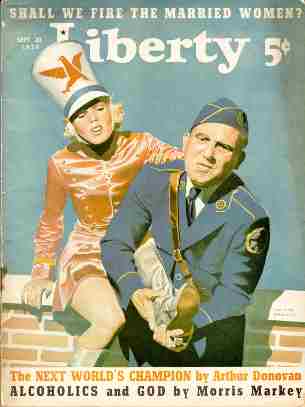
Liberty Magazine Cover, September 30, 1939
In September 1939, when the “Liberty” piece hit the newsstands, Bill thought it was a bit lurid, and that the title, “Alcoholics and God,” would scare off some prospects. Perhaps it did, but “Liberty” received 800 urgent pleas for help, which were promptly turned over to Bill Wilson who turned them over to Ruth Hock for a response. “She wrote fine personal letters to every one of them,” wrote Bill, “enclosing a leaflet which described the A.A. book. The response was wonderful. Several hundred books sold at once at full retail price of $3.50. Even more importantly, we struck up a correspondence with alcoholics, their friends, and their families all over the country.” When Dr. Bob read the story he was elated. “You never saw such an elated person in your life,” said Ernie G. the second (there were two Ernie G’s). “We all were,” said Ernie’s wife, Ruth. Anne smith said, “You know, it looks like we might be getting a little bit respectable.” It was AA’s first successful piece of national publicity. The stories in the Cleveland Plain Dealer followed shortly thereafter. One result of the article was that A.A. was started in Philadelphia. George S. of Philadelphia, one of the first “loners” had sobered up after reading the article. When the issue of Liberty first arrived, George was in bed drinking whiskey for his depression and taking laudanum for his colitis. The Markey piece hit George so hard that he went ex-grog and ex-laudanum instantly. He wrote to New York, his name was given to Jim Burwell (see “The Vicious Cycle” in the Big Book), who was a traveling salesman, “and that’s how A.A. started in the City of Brotherly Love,” wrote Bill. Jim and George gathered others to them, and the first A.A. meeting in Philadelphia was held in George’s home. Chicago also reported getting several new prospects as a result of the “Liberty” article. Bill wrote to Dr. Bob, “We are growing at an alarming rate, although I have no further fear of large numbers.” A few weeks later he wrote Dr. Bob that “the press of newcomers and inquiries was so great that we have to swing more to the take-it-or-leave-it attitude, which, curiously enough, produces better results than trying to be all things at all times at all places to all men.” (Sources: Alcoholics Anonymous Comes of Age. Bill W., by Francis Hartigan. Bill W., by Robert Thomsen. The Language of the Heart, Bill W.’s Grapevine Writings. Dr. Bob and the Good Oldtimers.)
“Alcoholics and God”
by Morris Markey
Is there hope for habitual drunkards?
A cure that borders on the miraculous — and it works! For twenty-five or thirty cents we buy a glass of fluid which is pleasant to the taste, and which contains within its small measure a store of warmth and good-fellowship and stimulation, of release from momentary cares and anxieties. That would be a drink of whisky, of course — whisky, which is one of Nature’s most generous gifts to man, and at the same time one of his most elusive problems. It is a problem because, like many of his greatest benefits, man does not quite know how to control it. Many experiments have been made, the most spectacular being the queer nightmare of prohibition, which left such deep scars upon the morals and the manners of our nation. Millions of dollars have been spent by philanthropists and crusaders to spread the doctrine of temperance. In our time the most responsible of the distillers are urging us to use their wares sensibly, without excess. But to a certain limited number of our countrymen neither prohibition nor wise admonishments have any meaning, because they are helpless when it comes to obeying them. I speak of the true alcoholics, and before going any further I had best explain what that term means. For a medical definition of the term, I quote an eminent doctor who, has spent twenty-five years treating such people in a highly regarded private hospital: “We believe . . . that the action of alcohol in chronic alcoholics is a manifestation of an allergy – that the phenomenon of craving is limited to this class and never occurs in the average temperate drinker. These allergic types can never safely use alcohol in any form at all.” They are, he goes on, touched with physical and mental quirks that prevent them from controlling their own actions. They suffer from what some doctors call a “compulsion neurosis.” They know liquor is bad for them but periodically; they are driven by a violent and totally uncontrollable desire for a drink. And after that first drink, the deluge. Now these people are genuinely sick. The liquor habit with them is not a vice. It is a specific illness of body and mind, and should be treated as such. By far the most successful cure is that used by the hospital whose head doctor I have quoted. There is nothing secret about it. It has the endorsement of the medical profession. It is, fundamentally, a process of dehydration: of removing harmful toxins from all parts of the body faster than Nature could accomplish it. Within five or six days — two weeks at the maximum — the patient’s body is utterly free from alcoholic poisons. Which means that the physical craving is completely cured, because the body cries out for alcohol only when alcohol is already there. The patient has no feeling of revulsion toward whisky. He simply is not interested in it. He has recovered. But wait. How permanent is his recovery? Our doctor says this: “Though the aggregate of full recoveries through physical and psychiatric effort its considerable, we doctors must admit that we have made little impression upon the problem as a whole. For there are many types which do not respond to the psychological approach. “I do not believe that true alcoholism is entirely a matter of individual mental control. I have had many men who had, for example, worked for a period of months on some business deal that was to be settled on a certain date . . . For reasons they could not afterward explain, they took a drink a day or two prior to the date . . . and the important engagement was not even kept. These men were not drinking to escape. They were drinking to overcome a craving beyond their mental control. “The classification of alcoholics is most difficult. There are, of course, the psychopaths who are emotionally unstable . . . They are over remorseful and make many resolutions — but never a decision. “There is the type who is unwilling to admit that he cannot take a drink just like the rest of the boys. He does tricks with his drinking — changing his brand, or drinking only after meals or changing his companions. None of this helps him strengthen his control and be like other people. Then there are types entirely normal in every respect except in the effect which alcohol has upon them . . . “All these, and many others, have one symptom in common: They cannot start drinking without developing the phenomenon of craving . . . The only relief we have to suggest is complete abstinence from alcohol. “But are these unfortunate people really capable, mentally, of abstaining completely? Their bodies may be cured of craving. Can their minds be cured? Can they be rid of the deadly compulsion neurosis?” Among physicians the general opinion seems to be that chronic alcoholics are doomed. But wait! Within the last four years, evidence has appeared which has startled hard-boiled medical men by proving that the compulsion neurosis can be entirely eliminated. Perhaps you are one of those cynical people who will turn away when I say that the root of this new discovery is religion. But be patient for a moment. About three years ago a man appeared at the hospital in New York of which our doctor is head physician. It was his third “cure.” Since his first visit he had lost his job, his friends, his health, and his self-respect. He was now living on the earnings of his wife. He had tried every method he could find to cure his disease: had read all the great philosophers and psychologists. He had tried religion but he simply could not accept it. It would not seem real and personal to him. He went through the cure as usual and came out of it in very low spirits. He was lying in bed, emptied of vitality and thought, when suddenly, a strange and totally unexpected thrill went through his body and mind. He called out for the doctor. When the doctor came in, the man looked up at him and grinned.
“Well, doc,” he said, “my troubles are all over. I’ve got religion.”
“Why, you’re the last man . . .”
“Sure, I know all that. But I’ve got it. And I know I’m cured of this drinking business for good.” He talked with great intensity for a while and then said, ” Listen, doc. I’ve got to see some other patient — one that is about to be dismissed.” The doctor demurred. It all sounded a trifle fanatical. But finally he consented. And thus was born the movement which is now flourishing with almost sensational success as Alcoholics Anonymous.” Here is how it works:
Every member of the group — which is to say every person who has been saved — is under obligation to carry on the work, to save other men. That, indeed, is a fundamental part of his own mental cure. He gains strength and confidence by active work with other victims. He finds his subject among acquaintances, at a “cure” institution or perhaps by making inquiry of a preacher, a priest, or a doctor. He begins his talk with his new acquaintance by telling him the true nature of his disease and how remote are his chances for permanent cure. When he has convinced the man that he is a true alcoholic and must never drink again, he continues:
“You had better admit that this thing is beyond your own control. You’ve tried to solve it by yourself, and you have failed. All right. Why not put the whole thing into the hands of Somebody Else?” Even though the man might be an atheist or agnostic, he will almost always admit that there is some sort of force operating in the world-some cosmic power weaving a design. And his new friend will say:
“I don’t care what you call this Somebody Else. We call it God. But whatever you want to call it, you had better put yourself into its hands. Just admit you’re licked, and say, `Here I am, Somebody Else. Take care of this thing for me.'” The new subject will generally consent to attend one of the weekly meetings of the movement. He will find twenty-five or thirty ex-drunks gathered in somebody’s home for a pleasant evening. There are no sermons. The talk is gay or serious as the mood strikes. The new candidate cannot avoid saying to himself, “These birds are ex-drunks. And look at them! They must have something. It sounds kind of screwy, but whatever it is I wish to heaven I could get it too.” One or another of the members keeps working on him from day to day. And presently the miracle. But let me give you an example: I sat down in a quiet room with Mr. B., a stockily built man of fifty with a rather stern, intelligent face. “I’ll tell you what happened a year ago.” He said, “I was completely washed up. Financially I was all right, because my money is in a trust fund. But I was a drunken bum of the worst sort. My family was almost crazy with my incessant sprees.” “I took the cure in New York.” (At the hospital we have mentioned.) “When I came out of it, the doctor suggested I go to one of these meetings the boys were holding. I just laughed. My father was an atheist and had taught me to be one. But the doctor kept saying it wouldn’t do me any harm, and I went. “I sat around listening to the jabber. It didn’t register with me at all. I went home. But the next week I found myself drawn to the meeting. And again they worked on me while I shook my head. I said, ‘It seems O.K. with you; boys, but I don’t even know your language. Count me out.’ “Somebody said the Lord’s Prayer, and the meeting broke up. I walked three blocks to the subway station. Just as I was about to go down the stairs – bang!” He snapped fingers hard. “It happened! I don’t like that word miracle, but that’s all I can call it. The lights in the street seemed to flare up. My feet seemed to leave the pavement. A kind of shiver went over me, and I burst out crying. “I went back to the house where we had met, and rang the bell, and Bill let me in. We talked until two o’clock in the morning. I haven’t touched a drop since, and I’ve set four other fellows on the same road.” The doctor, a nonreligious man himself, was at first utterly astonished at the results that began to appear among his patients. But then he put his knowledge of psychiatry and psychology to work. These men were experiencing a psychic change. Their so-called “compulsion neurosis” was being altered — transferred from liquor to something else. Their psychological necessity to drink was being changed to a psychological necessity to rescue their fellow victims from the plight that made themselves so miserable. It is not a new idea. It is a powerful and effective working out of an old idea. We all know that the alcoholic has an urge to share his troubles. Psychoanalysts use this urge. They say to the alcoholic, in basic terms: “You can’t lick this problem yourself. Give me the problem — transfer the whole thing to me and let me take the whole responsibility.” But the psychoanalyst, being of human clay, is not often a big enough man for that job. The patient simply cannot generate enough confidence in him. But the patient can have enough confidence in God — once he has gone through the mystical experience of recognizing God. And upon that principle the Alcoholic Foundation rests. The medical profession, in general, accepts the principle as sound. “Alcoholics Anonymous” have consolidated their activities in an organization called the Alcoholic Foundation. It is a nonprofit-making enterprise. Nobody connected with it is paid a penny. It is not a crusading movement. It condemns neither liquor nor the liquor industry. Its whole concern is with the rescue of allergic alcoholics, the small proportion of the population who must be cured or perish. It preaches no particular religion and has no dogma, no rules. Every man conceives God according to his own lights. Groups have grown up in other cities. The affairs of the Foundation are managed by three members of the movement and four prominent business and professional men, not alcoholics, who volunteered their services. The Foundation has lately published a book, called Alcoholics Anonymous. And if alcoholism is a problem in your family or among your friends, I heartily recommend that you get hold of a copy. It may very well help you to guide a sick man — an allergic alcoholic — on the way to health and contentment.